The woman
Cecilia Helena Payne was born on 10 May 1900 in Wendover, Buckinghamshire. She won a scholarship to Newnham College, Cambridge, in 1919, intending natural sciences. A lecture by Arthur Eddington on the 1919 eclipse expedition turned her toward astronomy. She completed the work Cambridge allowed women to complete. It did not, then, give them the degree.
She heard Harlow Shapley, new director of the Harvard College Observatory, lecture in London. She told him she wanted to work with him. In 1923 she crossed the Atlantic. At Harvard she found Annie Jump Cannon, curator of the astronomical photographs, and a mountain of spectra already ordered into classes: O, B, A, F, G, K, M.
The problem
The spectra looked like a zoo. Different stars showed different lines. The easy story was that different stars were made of different things, the way rocks are. Cannon’s sequence already hinted otherwise: it looked like a temperature sequence. What was missing was a physical account of why a given temperature showed a given set of lines.
In 1920 Meghnad Saha, in India, published an ionization equation. It said which atoms, at which temperature and pressure, would be stripped of electrons and therefore which lines would appear. Payne saw that the Harvard classes could be read as ionization, not as a set of recipes.
An impossible abundance
She calculated relative abundances for eighteen elements. Most metals sat near the proportions known in Earth’s crust. Hydrogen and helium did not. They came out overwhelmingly more common: the stuff of stars, not a trace.
That contradicted the working assumption of the time, shared by Henry Norris Russell at Princeton, that stars were Earth-like in composition, heated. Shapley sent the thesis to Russell. On 14 January 1925 Russell wrote that it was clearly impossible hydrogen should be a million times more abundant than the metals, and that something was seriously wrong with the present theory.
The enormous abundance derived for these elements in the stellar atmosphere is almost certainly not real.
The qualification
Russell sat on her committee. She kept the calculation and added the footnote. In 1925 she became the first person to earn a Ph.D. in astronomy from Radcliffe College. The full title is Stellar Atmospheres: A Contribution to the Observational Study of High Temperature in the Reversing Layers of Stars.
In 1929 Russell, by another method, found the same abundances (Astrophysical Journal 70, 11). He cited her. Hydrogen and helium are most of a star. Earth is not a fair sample of the sky.
ASTRONOMY
What a star became
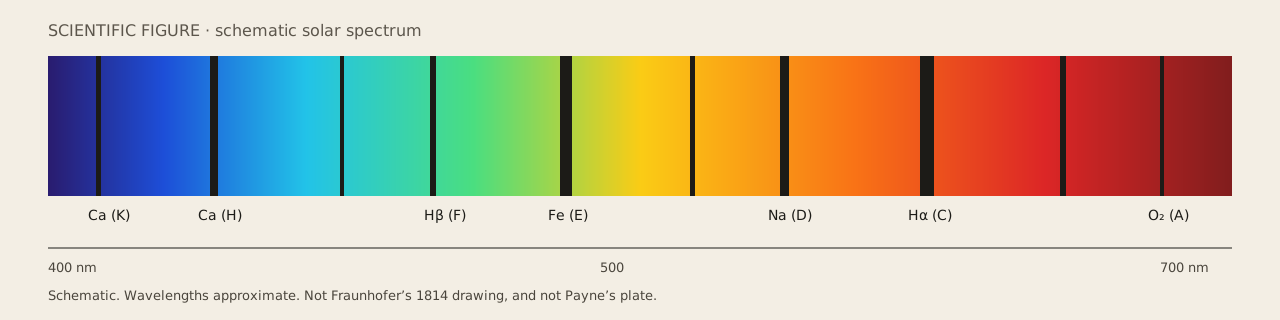
A stellar spectrum is not a picture of a surface in the ordinary sense. It is light minus the wavelengths atoms stole on the way out. Temperature sets which stolen lines you see. Once that is understood, composition can be read. Stars are glowing spheres of mostly hydrogen and helium. The Sun is one of them. That is now ordinary. In 1925 it was an offense against common sense.
What happened to her
She stayed at Harvard. For years the titles were smaller than the work. In 1934 she married Sergei Gaposchkin. In 1956 she became the first woman promoted to full professor from within Harvard’s Faculty of Arts and Sciences, and chair of astronomy. She wrote on variable stars and high-luminosity stars. She died in 1979.
Later she wrote that she had given in to authority when she believed she was right. “I was to blame for not having pressed my point. If you are sure of your facts, you should defend your position.” She noted it as a warning to the young.