
The problem in the glass
Joseph Fraunhofer is trying to measure glass. Colors in a prism have soft edges. He needs sharp marks. In 1814, passing sunlight through a narrow slit and a flint-glass prism, he finds almost countless dark lines across the spectrum.
He maps more than 570. The strongest still carry his letters, A through K. He does not yet know they are chemistry. He knows they are fixed enough to measure by.
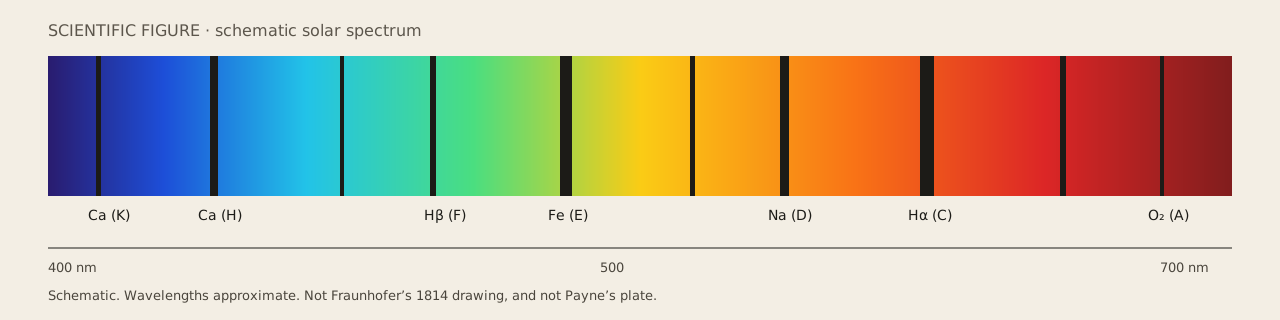
SCIENTIFIC FIGUREA schematic of absorption lines across a solar spectrum. Not Fraunhofer’s original drawing.
ASTRONOMY
What the gaps are
The lines are absorptions. Atoms in the solar atmosphere take out particular wavelengths from the photosphere’s light. Kirchhoff and Bunsen, decades later, showed that laboratory flames make bright lines at the same places. The rainbow was never only a smooth ribbon. In 1814 it was a set of marks fixed enough to measure by. What those marks were made of is a later language.
Question
How do you weigh a star you cannot touch, using only the light it spent?