The room
Robert Bunsen has been at Heidelberg since 1852. He brings Gustav Kirchhoff from Breslau. They work in the city palace called Haus zum Riesen, on the Hauptstraße. Bunsen’s burner gives a hot, almost colorless flame. Salts held in it on a platinum wire do not paint the fire so much as they paint a few sharp colors.
Colored flames had been a chemist’s nuisance and a glassblower’s hint. Kirchhoff’s suggestion is to split that light with a prism and look. They build a spectral apparatus: a trapezoidal box on three legs, two small telescopes, a slit, a prism between the objectives. Rotate the prism. The spectrum of the flame walks past the eyepiece. The lines can be measured.
The coincidence
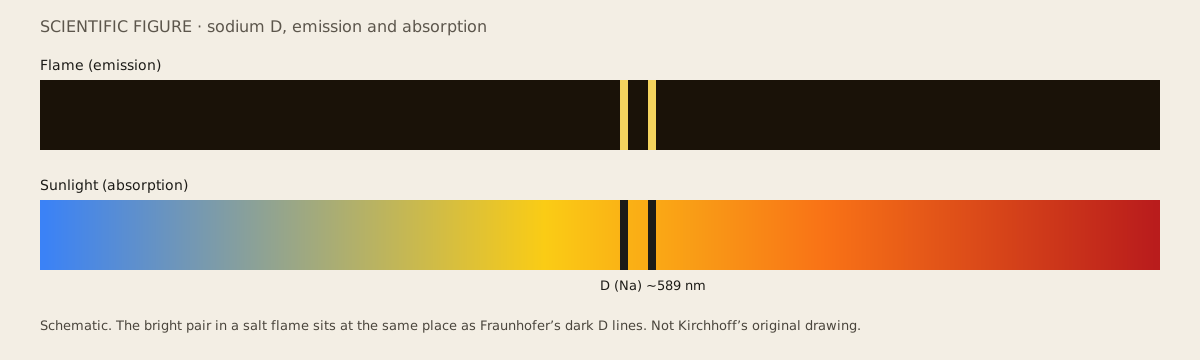
A sodium salt makes a bright yellow pair. Fraunhofer had already lettered the strongest dark pair in sunlight D. The bright pair and the dark pair occupy the same place in the spectrum. That could still have been an accident of glass, or of the air in the room.
Kirchhoff brings sunlight and the flame to the same slit. When the salt flame stands in front of a brighter continuum, the yellow pair goes dark. Emission and absorption are the same wavelengths. A body that can emit at a line can take at that line. The rainbow’s missing teeth are not a defect of the prism. They are atoms.
ASTRONOMY
What they could say then
The Sun, it follows, has sodium in its atmosphere. A star has become a sample you can compare with a jar on the bench. They could not yet say why a given temperature shows a given set of lines. They could not count hydrogen. They had a method: the lines are signatures, and the signatures match.
After
In 1860 they publish the long paper on chemical analysis by spectrum. Cesium and rubidium appear as new lines in other flames, named for their colors, sky-blue and deep red. The Sun will keep being read this way for the rest of the century. Hydrogen as the stuff of stars is a later calculation, in another observatory, by a woman who already has this method under her feet.