The bureau
Kaifeng has an Astronomical Bureau because the emperor’s sky is part of the emperor’s work. Yang Weide is its director in the first year of the Zhihe era, under Emperor Renzong. The office is to notice what appears, where it sits, how long it stays, and what the inherited books say it means.
On the twenty-sixth day of the fifth lunar month, a jichou day, later counted as 4 July 1054, a guest star appears at daybreak in the east. It guards Tianguan, the star we call Zeta Tauri, the southern horn of Taurus. The sky had been empty there. It is not empty now.
What they wrote
The Song Huiyao keeps the daylight. The Song Shi keeps the long stay. They are not the same sentence, and they are not a contradiction once the two clocks are allowed to stand.
It appeared at daybreak at the eastern direction, guarding Tianguan. It was seen in the daytime, like Venus. It had pointed rays in all directions and its colour was pale red. In total it was seen in daylight for 23 days.
Twenty-one months
Daylight lasts twenty-three days. Night lasts much longer. The Song Shi says that after a year and more the guest gradually vanished. The last court sighting is recorded in the third lunar month of the first year of Jiayou, 6 April 1056 in the later calendar: about 642 days after it arrived.
In 1055 the attendant censor Zhao Bian is still looking at it. A full year has passed, he tells the throne, and its brilliance has not faded. He calls it a baleful star. Yang Weide’s earlier memorial had read the same light as auspicious: it did not trespass on the lodge Bi, and so a person of great worth was in the realm. Same lamp. Two offices. The bureau writes both kinds of sentence.
The guest as the court clocks it. Lunar dates converted. The conversions are later work.
| When | What the record keeps |
|---|---|
| 4 July 1054 | Appears at dawn in the east, guarding Tianguan |
| Twenty-three days | Seen in daylight, like Venus, pale red, pointed rays |
| 1055 | Zhao Bian: a full year, and it has not faded |
| 6 April 1056 | Last Song court sighting. About 642 days. Then it is gone |
Other skies
In Japan the diary Meigetsuki, written in the thirteenth century by the poet Fujiwara no Teika, keeps a guest star in the lodges Zui and Shen, emerging at Tianguan, as large as Jupiter, seen in the east in the hour of chou, one to three in the morning. Teika is not standing in 1054. He is copying an earlier Japanese notice into a later book. The date he preserves sits in a different lunar month than Kaifeng’s. The light is the same kind of fact. The paperwork is not the same hand.
Ibn Butlan, a Christian physician moving between Cairo and Constantinople, writes of a spectacular star in the year 446 of the Hijra, 1054 of the later calendar, in a season of epidemic. He places the star in Gemini. Fourteen thousand buried in Constantinople, he says, and later illness in Old Cairo when the Nile was low. Whether that spectacular star is the guest at Tianguan is argued. Gemini is not Taurus. The epidemic is his subject. The star is a dating mark in a medical page. Do not make him a court astronomer of Kaifeng.
ASTRONOMY
What it was, later
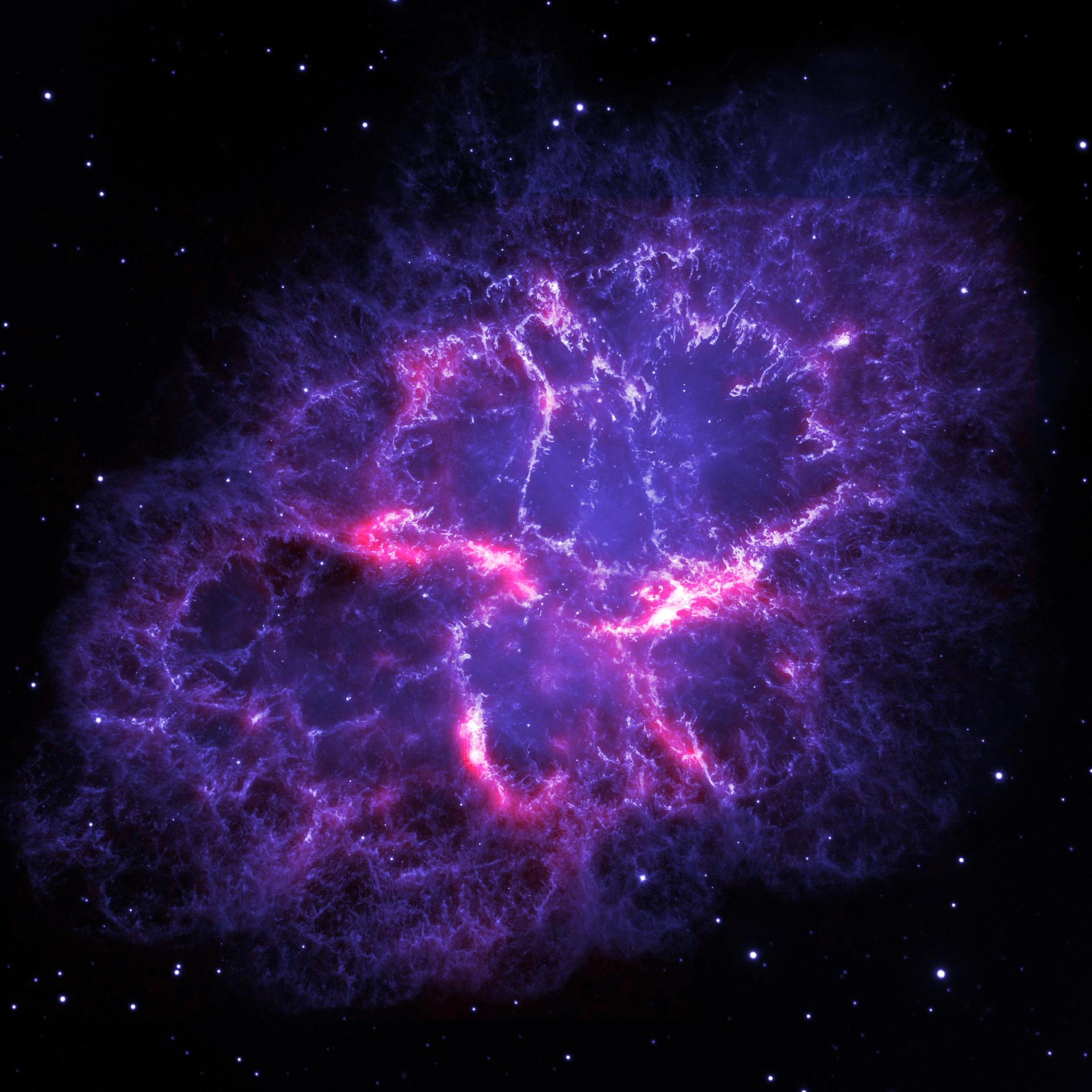
The light was a supernova about 6,500 light-years away. The remnant is the Crab Nebula. A pulsar turns at its heart. Yang Weide did not have that physics. He had a guest, a duration, a place against Tianguan, a color, and a duty to the record.
Western readers met the Chinese notices in the nineteenth century, through Édouard Biot’s translations. Knut Lundmark compiled guest stars in 1921 and noted the 1054 light near the nebula we now number M1. Nicholas Mayall argued the link in 1939 from the remnant’s expansion. Jan Oort and J. J. L. Duyvendak put the identification beyond reasonable doubt in 1942. The wreckage in the modern photograph is not the Song page. They wrote down a guest. We now say a star died.
THE FENCE
What the page will not tidy
Song Shi places the guest southeast of Tianguan, perhaps several inches away. The Crab sits northwest of Zeta Tauri. The mismatch is in the sources. It may be a copyist, an indirect measure, dust in a dry year. It is not ours to correct into a perfect map.
kè xīng means guest star: a light that arrives where the maps had none. It is not yet supernova. Historical astrology is an office of this court. It is not a failed astrophysics, and astrophysics is not a proof of the memorial.