The waiting
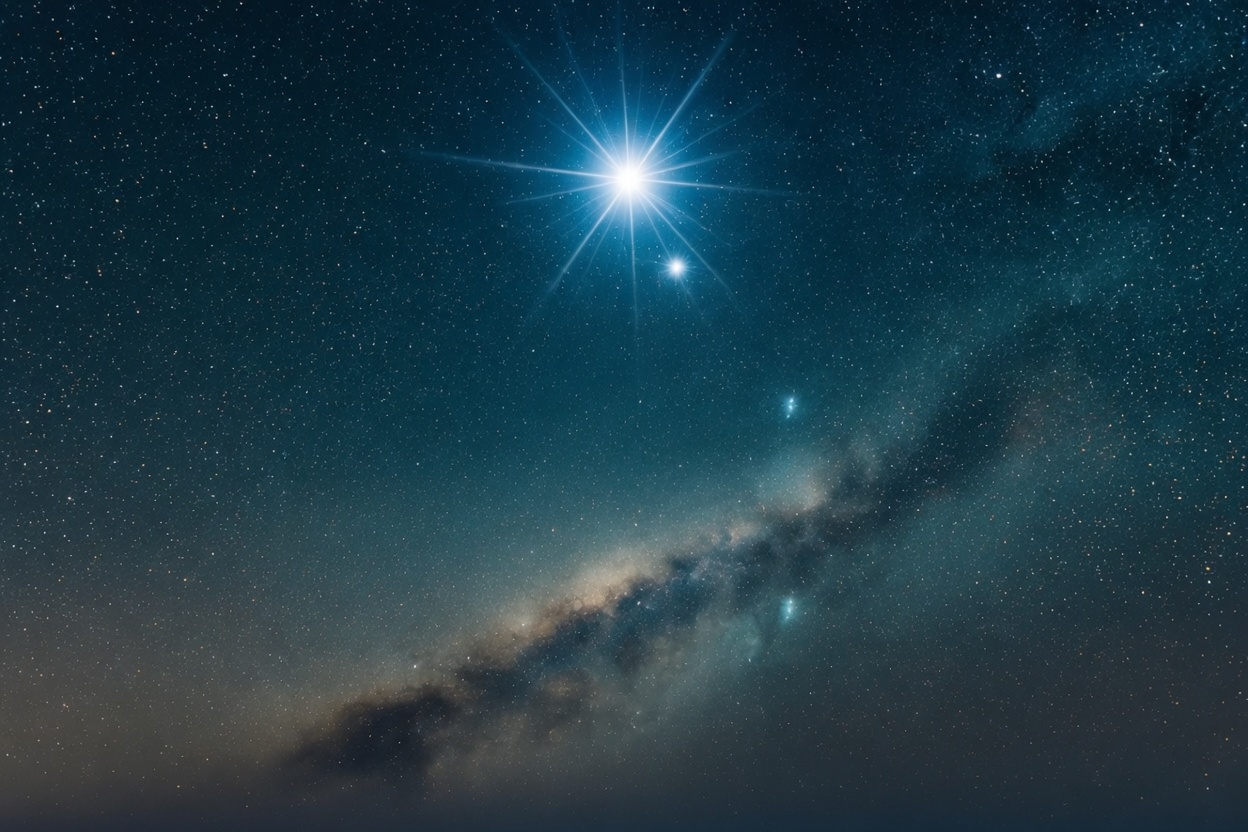
For weeks the brightest night star has been missing. It has been walking with the Sun, lost in glare. Then, on a morning that does not announce itself, it is there again: a white lamp on the eastern horizon, just ahead of dawn.
In Egypt that return was watched. It marked Wepet-Renpet, the opening of the year. It came in the season of the inundation, the water on which planting depended. A farmer did not need an observatory. A priest did not need a theory of hydrogen. They needed the light to come back.
What they could know
They could know recurrence. The sky returns. The river, in a good year, returns. The civil year of 365 days, counted without a leap, slowly slipped against that return. Later scholars named the long slip the Sothic cycle, about 1,460 years. Chronologists have used recorded heliacal dates as anchors. The reconstructions remain argued.
They could not know that the lamp is a pair of stars 8.60 light-years away, A1V and a white dwarf, apparent magnitude about −1.46. That is our office, not theirs.
ASTRONOMY
The light
Sirius is α Canis Majoris. The light reaching a dawn watch in Egypt had already been travelling a little under nine years. Heliacal rising is local. Change the latitude, the haze, the height of the eastern hills, and the date moves. It was never one world calendar.
MYTH
Sopdet
Sopdet is a goddess as well as a star. Later tradition links her with Isis. That is religion. It is not a primitive attempt at astrophysics, and astrophysics is not a proof of the cult. The name and the lamp occupy the same sky. They are not the same kind of claim.
Question
What kind of clock is a star that can be late, or early, depending on where you stand?