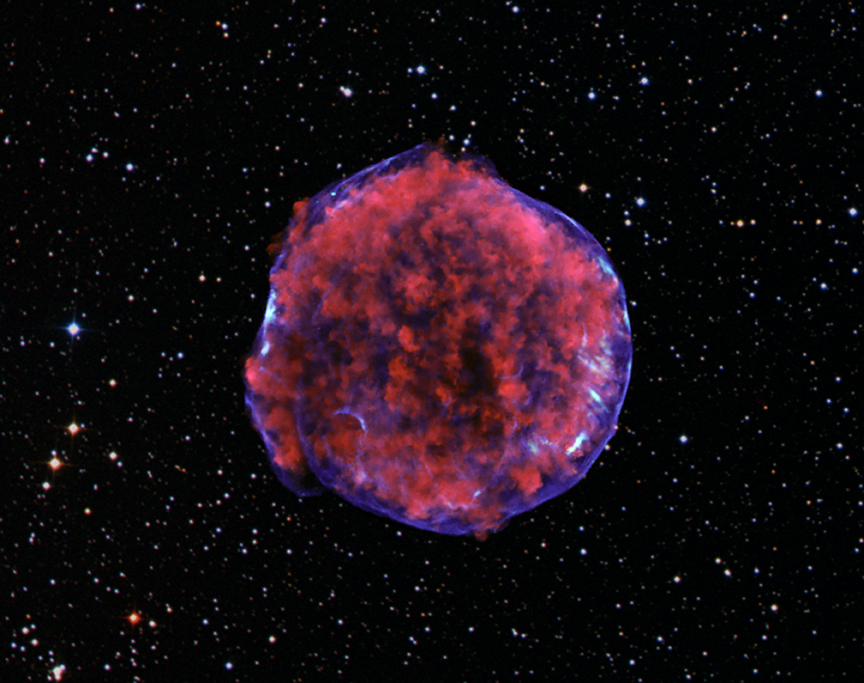
The new star
On 11 November 1572 Tycho Brahe, at Herrevad Abbey, sees a light in Cassiopeia that is not on the maps. It is as bright as Venus. It will be visible for about eighteen months.
Aristotle’s heavens beyond the Moon were not supposed to generate or perish. Other observers try to keep the new thing below the Moon, in the changing air. Tycho measures. The light shows no daily parallax against the fixed stars. It is at least farther than the Moon.
Hence this new star is located neither in the elemental region, below the Moon, nor in the orbits of the seven wandering stars, but in the eighth sphere, among the other fixed stars.
ASTRONOMY
The object was a supernova, now SN 1572. Tycho did not have that word. He had a sextant with arms five and a half feet long, a table of its errors, and a refusal to put the light in the air because the numbers would not allow it.
What did not follow
He published. He became famous among astronomers. He did not, that year, abandon a central Earth. Wrong models can survive a true observation. The observation still stands: the eighth sphere had changed.