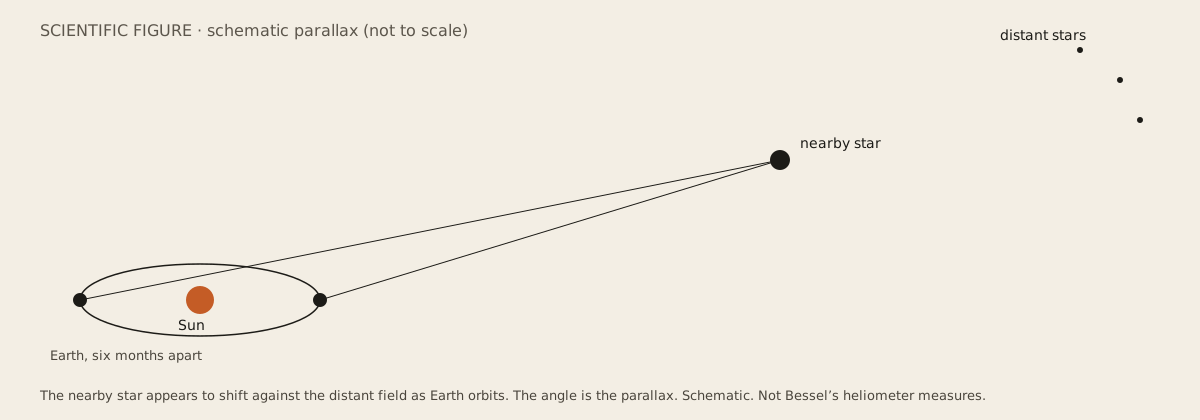
Why this star
Friedrich Wilhelm Bessel chooses 61 Cygni because it moves. Large proper motion suggested it was nearby, and Königsberg could watch it all year. Joseph von Fraunhofer had built a heliometer, a split-image telescope for tiny angles. Bessel uses it.
The number he publishes is 0.314 ± 0.020 arcseconds. Converted: a thirty-centimetre pizza subtends that angle from about 197 kilometres. The comparison is ours, for scale. It is not Bessel’s sentence. A later explainer used New York as seen from San Francisco. That sightline is about 4,100 kilometres, which would make the object more than six metres across. The pizza only works if the distance is two hundred kilometres, not a continent.
The angle, shown as an object at a distance. Schematic arithmetic, not an 1838 instrument reading.
| Quantity | Value |
|---|---|
| Bessel’s parallax, 61 Cygni | 0.314 ± 0.020 arcseconds |
| That angle in radians | 0.314 / 206,265 ≈ 1.52 × 10⁻⁶ |
| Object 30 cm across at that angle | ~197 km |
| New York–San Francisco at that angle | an object ~6 m across |
| Modern distance to 61 Cygni | ~11.4 light-years |
ASTRONOMY
He published a parallax of 0.314 ± 0.020 arcseconds, a distance of about 10.4 light-years. Modern value for 61 Cygni is about 11.4. The first reliable step on a stellar ruler had been taken. The universe, already large, had a number attached to one lamp.