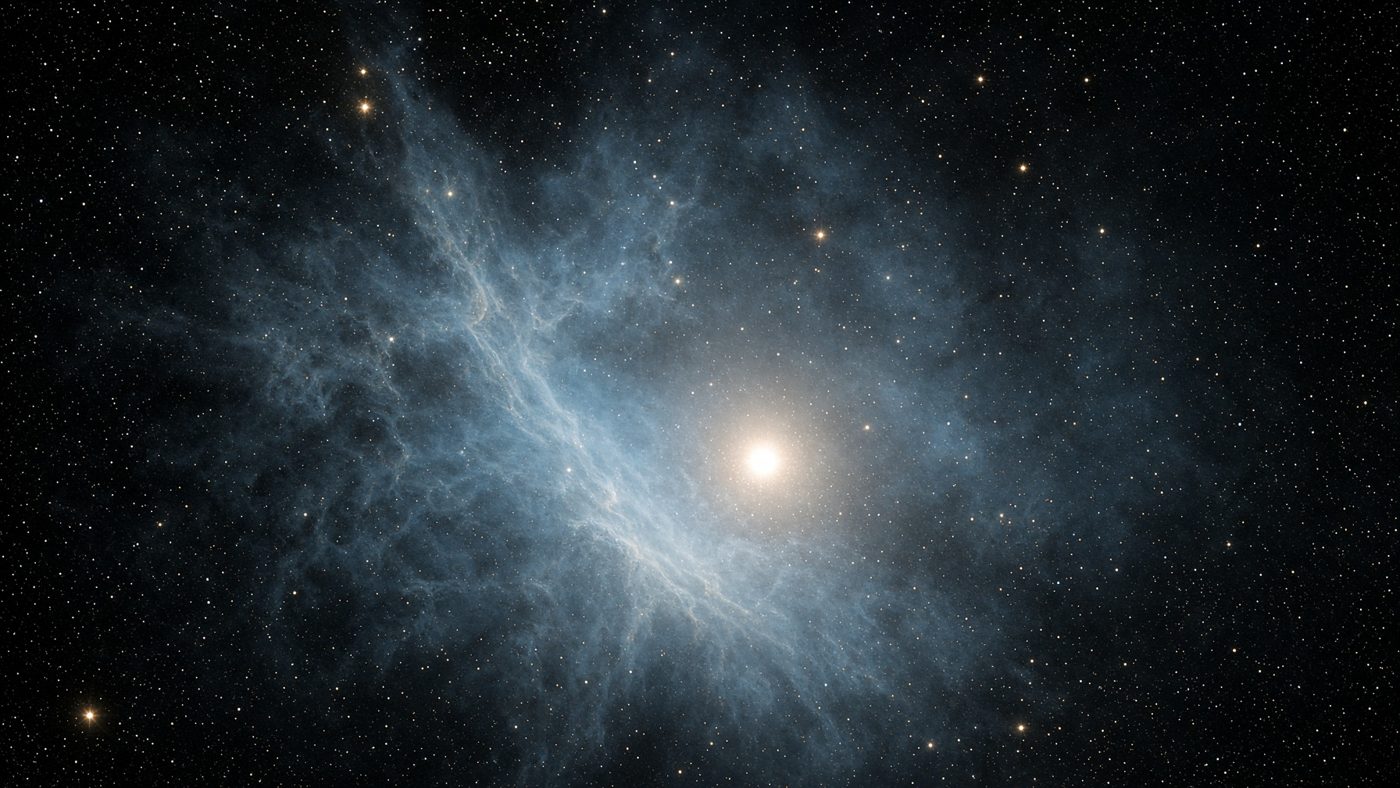
cluster · Taurus · Pleiades · a plate in Stars
Merope
23 Tauri
She thought the difficulty was the star. The measurement said otherwise. Then thirty arcseconds away, another difficulty appeared.
The sister you see by looking differently. Seven names. A naked-eye count that has never sat still. Greece gave the gap a face. The night does not hide her.
From the letters
“How did humanity declare a myth about Merope before astronomers confirmed that this star did indeed grow faint and is now at an average magnitude of 4.2? The myth said she dimmed because she married a mortal, and the sky reflected her story.”
Astronomy · astrophysics
- Magnitude
- 4.18 (often printed 4.2)
- Distance
- about 444 light-years
- Spectrum
- B6 IVe
- Coordinates
- 3h 46m · +23° 57′
Two veils: NGC 1435, the broad reflection; IC 349, a knot thirty to thirty-six arcseconds away.
23 Tau. Blue-white B6 subgiant. Visual magnitude about 4.18. Fourth among the named sisters, after Alcyone, Electra, and Maia.
The catalogue is 4.18. Rounded once, the face is 4.2. It is not 4.20. A star belongs to the strict 4.2 class only if one-decimal rounding lands on 4.2: 4.15 to just under 4.25. In the principal named Pleiades, only Merope enters it. Taygeta is about 4.29, which rounds to 4.3.
NGC 1435 is a reflection nebula, not fire. The Pleiades are too old to wear birth-dust. They are passing through an interstellar cloud. She lights what she did not make.
IC 349 sits thirty to thirty-six arcseconds from the star, about thirteenth magnitude. Herbig measured the knot as the brightest patch in the Pleiades nebulosity, about fifteen times the surrounding veil. The difficulty is contrast: a lamp of 4.18 beside a thirteenth-magnitude smear.
Averted vision is a laboratory method: rods off-axis. A glare may need the star covered. Two difficulties, two gestures.
Historical story · observation
The veil, then the knot
- 1859Wilhelm Tempel, with a modest refractor, recorded the broad reflection now catalogued NGC 1435.
- 14 November 1890E. E. Barnard at the Lick 36-inch found IC 349. He checked the other sisters, occulted Merope with a wire, then placed her outside the field, before he trusted the knot.
- Greece, long before the nebulaeSeven names. A naked-eye count that would not sit still. The myths gave the gap a face. The night does not hide Merope; the later instruments found a different difficulty thirty arcseconds away.
Living
She has a name. She has a place in the sky. And for thousands of years she has been the one no one can quite see.
The aperture does not create the star. It only changes whether you can bear to look beside the glare.
The original telling remains. The later chamber is the finer map. Merope is easier to see than that telling implied. The knot thirty arcseconds away is harder. The seeing survives. The object of difficulty became more precise.
She is not the veil. She illuminates what she is passing through. The same light that reveals can also conceal.
Stars · Pleiades · later looking
The sister you see by looking differently
She thought the difficulty was the star. The measurement said otherwise. Then thirty arcseconds away, another difficulty appeared. The letters of 9 November and 4 December 2025 asked the question before this chamber answered it.
01 · The sister
Seven names. Aratus already knew the count would not sit still: their number is seven, though the myths and the poets feign that one has passed away. Hyginus keeps a marriage to Sisyphus. Ovid leaves two doors: she hides because she chose a mortal, or Electra will not watch Troy burn.
02 · The star
23 Tauri is still burning in Taurus. Magnitude about 4.18. Among the named sisters she is fourth, not last. The night does not hide Merope.
03 · 4.18 → 4.2
Popular pages print 4.2. It is not 4.20. Only Merope of the principal named Pleiades lands in the one-decimal 4.2 class. Taygeta tempts the eye and then becomes 4.3.
04 · The lost sister
Six seen, seven named. Greece gave the gap a face. Subaru, Matariki, Aboriginal Seven Sisters answer the cluster. They do not retell Merope.
05 · The broad veil
Tempel, 1859. NGC 1435. Reflection. She lights borrowed grain. She lights what she did not make.
06 · Thirty arcseconds away
IC 349. Barnard at Lick, 14 November 1890. He refused to be fooled by a star. Only then did the knot hold.
07 · One light
The radiation that gilds the knot is the radiation that drowns it. The same light has opposite observational consequences.
10 · What the Book knows now
Merope is easier to see than the first telling implied. The knot thirty arcseconds away is harder. The seeing survives. The object of difficulty became more precise.
11 · The aperture
An instrument gathers light and can saturate it. It can separate two things that looked like one. It can also invent a ghost. A faint light may need the glance aside. A glare may need the star covered.
12 · What remains
The star survives without us. Look at her and the knot disappears. Cover her and the knot, which is only her light on borrowed dust, remains. What belongs to the star, and what belongs to the way we looked?
Sources
- SIMBAD 23 Tau
- NGC 1435 · Tempel 1859
- IC 349 · Barnard 1890
- Herbig Pleiades nebulosity
Choir
 Rotanev · SualocinSiriusIzar · PulcherrimaThubanCapellaRigelMeropeTolimanM42Jupiter · IoSpicaFomalhautArcturusAlhenaCanopus
Working choir · not a planetarium